
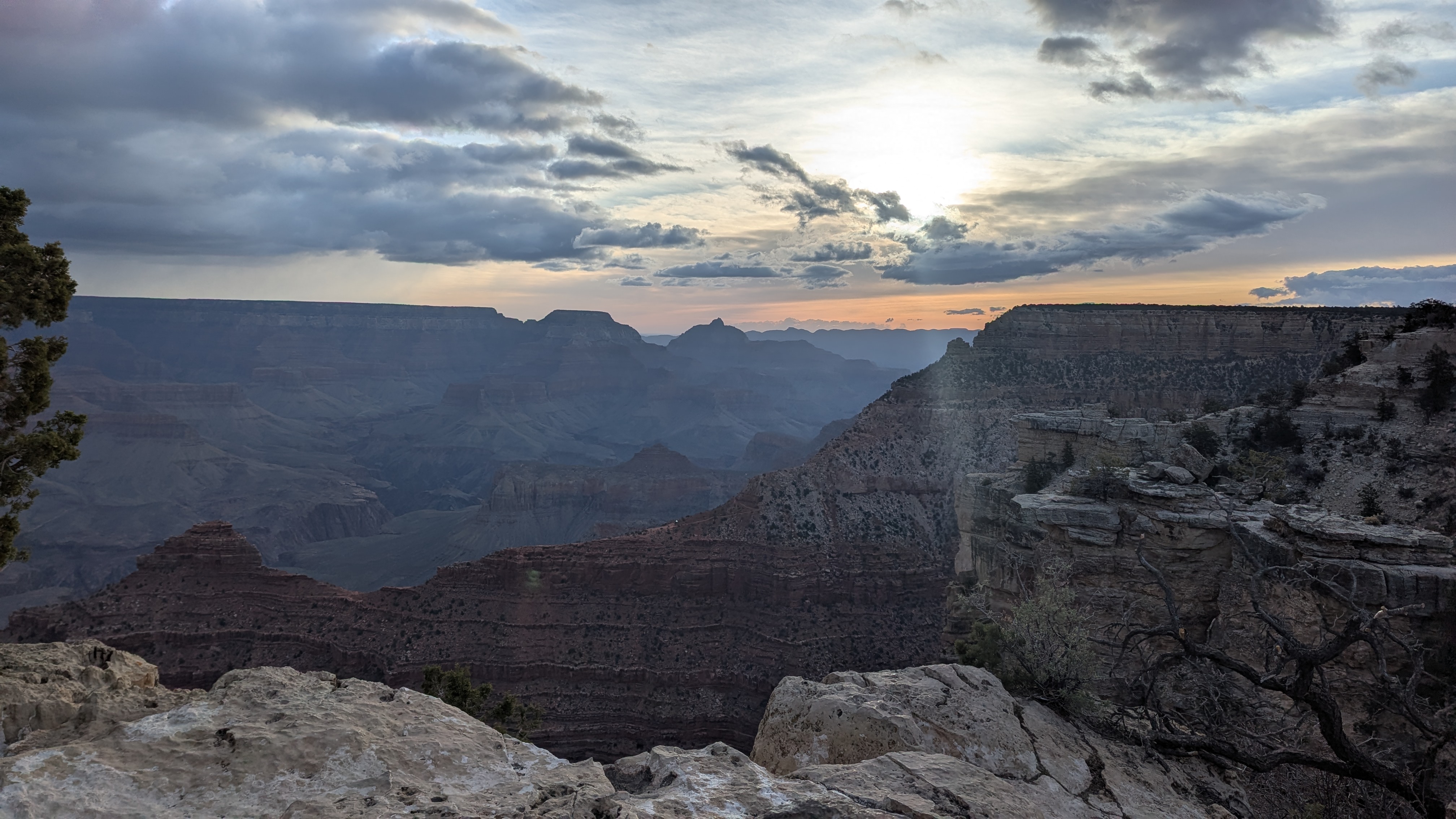
We’ve been at the Grand Canyon for the past week and a half and it’s been an amazing visit, full of wonder and intrigue. Somewhere, we came upon the fact that 5 million people per year visit the Grand Canyon, but the majority only spend two hours here at most. It’s true that if you don’t enjoy the outdoors or walking, you probably won’t have a lot to do. As one walker put it when I ran across him on one of the bike paths during a run – “there’s a giant hole in the ground over there.” Essentially, that’s what it is – but it’s also so much more than that. It’s one of the seven wonders of the world, not necessarily because it is a huge canyon, but because one tiny river carved out this wonder in a mere 6 million years. That’s unprecedented and shows the power and force of something so simple. There are a lot of lessons to be learned from the Grand Canyon and if you listen closely, they will tell you them all.
Layers Built Up Over Time Create a Grand Structure — But Even Rock Can Be Rewritten
There’s a quote I came across at the Yavapai Geological Museum — a small, somewhat underwhelming building with a lot of educational information and one unexpectedly powerful insight. It read:
“Given enough time, nothing is more changeable than rock.”
That line stuck with me. Because even the most solid structures — the ones we believe are unshakable — can eventually crumble under the most persistent forces.
Water, for instance. It’s fluid, unimposing. At first glance, it seems harmless. But it’s the greatest force of erosion on Earth. One tiny crack, one soft drip — given enough time — can reshape mountains. It only takes a small groove to form, and with just the right amount of pressure, the sides begin to collapse. That’s how the Grand Canyon came to be — not from a single dramatic event, but from the persistence of water. Over several millennia, the Colorado River carved deeper and deeper until one crack caused the sides to tumble down and then something breathtaking emerged.

From above, it might look stable now. But the water still flows. Still carves. Still changes the structure, year after year.


And in a moment of reflection, I saw a powerful image that reminded me of a powerful book.
In The Four Agreements by Don Miguel Ruiz (a book I highly recommend, by the way), there’s a lesson that mirrors this perfectly. The beliefs that shape our identity — our judgments, decisions, values — weren’t born with us. They were passed down, layer by layer, over time. Taught to us when we were young by parents, teachers, neighbors. And those people learned them from others before them. Just like sediment building up over centuries, these beliefs have settled into us and built up the very foundation and structure upon which our top layer of ground stands.

But what if those beliefs aren’t actually true for you?
What if they were never even yours to begin with?
To question those deeply embedded layers — and to start carving a path that’s truly your own — is one of the most radical acts of freedom. But like water meeting rock, that process can be slow and uncomfortable. It might cause friction. People close to you may resist it. They might withdraw love, attention, approval.
I know because I’ve lived it. When we set out on this RV trip — a decision deeply aligned with the life we wanted and the values we identified as our own (and it includes our kids as we had and continue to have many conversations with them on whether this aligns for them) — it stirred the waters. Some family members didn’t understand. Friends questioned it. The school system definitely didn’t approve. It would’ve been easier to stay where it felt “safe,” to keep building on top of someone else’s foundation. But safety can also be a cage, and we weren’t willing to stay trapped in a structure someone else designed.
So we opened the floodgates and let the water in. The change didn’t happen overnight. In fact, this trip took almost two years to plan and make happen. We had to sell a business, make plans to rent our home, clean it out, buy a larger RV and make it what we wanted, map the trip and timeline, figure out how to homeschool our kids and then determine what our systems and processes would look like each day and week to realize the goals we were setting for ourself.
But, little by little, we’ve carved something new. Some days the change feels invisible — like we’re inching forward with no noticeable difference. But we know now that’s how transformation really happens. Quietly. Persistently. And then suddenly, something gives and big change occurs — the whole landscape shifts and we see the grandness of what is left in the ruins of what we left behind.
That’s what alignment feels like.
That’s what self-confidence is.
This is the new value system replacing that of the old.
You won’t find it by building higher walls on someone else’s plan. You find it by trusting the gentle pressure of your own truth, even when it threatens to reshape everything.
In time, you’ll look up and realize you’ve created something grand. Not because it was fast. But because it was yours and because you were persistent and fluid in seeking your own truths.
“It takes a great man and one who has risen far above human weaknesses not to allow any of his time to be filched from him, and it follows that the life of such a man is very long because he has devoted himself wholly to whatever time he has had. None of it lay neglected and idle; none of it was under the control of another, for, guarding it most grudgingly, he found nothing that was worth to be taken in exchange for his time” – Seneca

The View from the Bottom Looks Very Different Than the View from the Top
And the Descent Is Always Easier Than the Climb Back Up
While visiting the Grand Canyon, our family hiked 1.5 miles down the Bright Angel Trail.
Now, don’t let that number fool you—it’s a steep drop of over 1,100 feet in elevation, across rocky terrain with more than a few precarious cliffside edges. And let’s not forget: the top sits nearly 8,000 feet above sea level. Definitely not what we’re used to given we’re from the coast of NC and spent much of the last six weeks close to the shores of TX.
All the way down, the kids were thrilled. “This is easy!” they shouted. “I can go further, Mommy!”
But we kept gently reminding them: What goes down must climb back up—and the way back up will feel very different.
To my surprise, I was incredibly present during the whole hike.
Partly because of the awe-inspiring beauty around us, partly because of the joy of sharing this with my family… and partly because I needed to keep a close eye on my youngest, who has a habit of turning any trail into her own personal race.
The climb back up was no joke. We stopped for water and short breathers more than a few times. Even I—someone who can run several miles without issue—was huffing a bit in that thin air.


Then, at the top, I paused for a moment to reflect.
Business, I thought, is a lot like this.
When things are going well, when the path is smooth and you’re cruising downhill, it’s easy to forget the work it took to get to that point. Momentum makes everything feel effortless. You think, I could go on like this forever.
But eventually, you hit a plateau—and the only path forward is back up. And that climb? It demands more of you. It reminds you of just how far you’ve come… and just how hard you worked to get here.
And the view from the top? It’s not necessarily better—but it is very, very different.
It’s clearer. Wiser. And well-earned.
That’s why I try to live by Dan Sullivan’s advice in The Gap and The Gain:
Take time to look back and appreciate how far you’ve come.
Don’t just chase the next summit.
Don’t forget what it took to reach the one you’re standing on now.
That day, my kids amazed me. At 7 and almost 10, this was no small feat. My oldest, especially, made no attempt to hide her feelings about the uphill climb (her facial expressions said it all). But at one point during a water break, we talked about doing hard things—and the pride that follows.
We don’t have to love every hard thing we do.
But we can love what we learn about ourselves along the way.
To my surprise, at the top she didn’t complain. She actually said she’d do more hikes. (Though I’m not convinced “challenging trails” will be her go-to fitness plan.)
The lessons don’t just live in what we can learn about business either. One of the most impactful books I’ve ever read was Seneca’s On the Shortness of Life.
In it, he wrote:
“Life is long enough… if the whole of it is well invested.”
He challenged the idea that life is short. Instead, he said we make it short—by spending it in pursuit of things that don’t matter, by waiting for “someday,” by saying, “I’ll do that when I’m 50 or 60 or retired.”
And then often, that day never comes.
Reading that book changed the way I thought about retirement, and time, and how I wanted to raise my kids. Why should we wait to take this trip (my husband and I had always said we would travel in our RV when we retired)? Why wait until my children are grown and explore the world without them?
Why spend years “earning” a future I might never get to experience—especially if I’m doing it just because someone else said that’s how it’s supposed to be?
When I reach the top of my proverbial mountain—whatever that looks like—I don’t want to look back and wonder where the time went.
I want to marvel at the path I took.
I want to remember the lessons, the people, the challenges, and the joy.
I want to know I spent it all wisely—with the people who matter most, building a life based on my values, not someone else’s blueprint.
That doesn’t happen by accident.
It happens when we stay present, invest our time with intention, and climb our own damn mountain—even when the way up is hard.
Final Thoughts: Sometimes Clouds and Snowstorms Get in the Way
“Everything in existence is a manifestation of the one living being we call God… and the world is an illusion. The Dream is like smoke, which doesn’t allow us to see who we really are.”
– Don Miguel Ruiz, The Four Agreements
He calls it Mitote — the fog of the mind. A confusion so thick, we can’t see ourselves clearly. The path to personal freedom, he says, begins with recognizing the fog.
During our time at the Grand Canyon, the sunny 60- and 70-degree days gave way to snowstorms and plunging temps. One afternoon, we drove toward Desert View Tower, excited to take in a new perspective — only to hit a sudden squall. What started as a few rolling clouds quickly turned into a whiteout.
The fog settled in, the snow poured down, and just like that… we could no longer see what was right in front of us.


It was a stunning metaphor for life.
Even the grandest, most awe-inspiring things can be hidden from view when the storm rolls in. Sometimes the clouds are outside of us.
But more often, they’re within.
Fear, self-judgment, inherited stories — they build up slowly, until the world becomes opaque. We can’t see our purpose, our desires, or even who we are anymore. I’ve lived inside that storm more than once.
After some personal setbacks and trying to keep our company alive through the pandemic, I found myself in a terrible place. The fog in my mind — the fear, the pressure, the confusion — was overwhelming. I couldn’t see who I was or who I was becoming. I just knew I couldn’t keep doing it the same way. To make things worse, for the survival of our family, my husband I decided I needed to get a job outside of the business and limit us having all of our eggs in one basket. The business was my third child and the separation extremely difficult for me. I identified as an entrepreneur, not an employee of another company. Fortunately, I ended up going to work for a company that offered up a wealth of possibility in leadership and challenged some of my views.
With other members of this new leadership team, I ended up in a workshop that challenged everything I thought I knew — and picked up a book that changed my life along the way (The Four Agreements). The fog didn’t lift all at once, but I started to see again. The leader spoke of alignment, love, and living with clarity. As they talked, I couldn’t write fast enough. My mind was flooded with thoughts:
I can’t control the actions of others.
I’m not being true to myself.
My husband and I have built something that isn’t in alignment — not for us, and not for what we want out of life.
I flew home and we had the conversation I’d been avoiding. We started peeling back the layers of fear — fear of disappointing business partners, family, even each other. We started asking what we actually wanted.
We knew we had to sell the company. We knew it was time to stop waiting for “someday” and start preparing for the RV trip we’d always talked about.
Over the next year, we climbed out of the debt our company had taken on during the pandemic. We paid back our partners and ourselves. We cleaned up our systems. And I did the internal work too — letting go of the anger I’d carried, especially toward my parents, and realizing they were just humans doing their best with what they had.
In the middle of all this, I also lost my brother — for the second time, really. Drugs had taken him long ago, but his physical passing marked a shift in my family. There was grief, yes, but also clarity. For the first time, it felt like we could all step out of the fog — and start living in the present.
Just like at the Grand Canyon, where the storm had once obscured everything around us, the clouds eventually parted. We could see the beauty that had been there all along.
And that’s the lesson in all of this – most especially for me:
Even when the view is hidden, the wonder still exists.
Even when fear clouds everything, alignment is still available if you seek it out.
But you have to be willing to pause. To notice. To do the work of clearing the fog.
When you do, you may find a vision more beautiful than you imagined — and a life that’s finally yours. And you may find true freedom.

Leave a Reply