
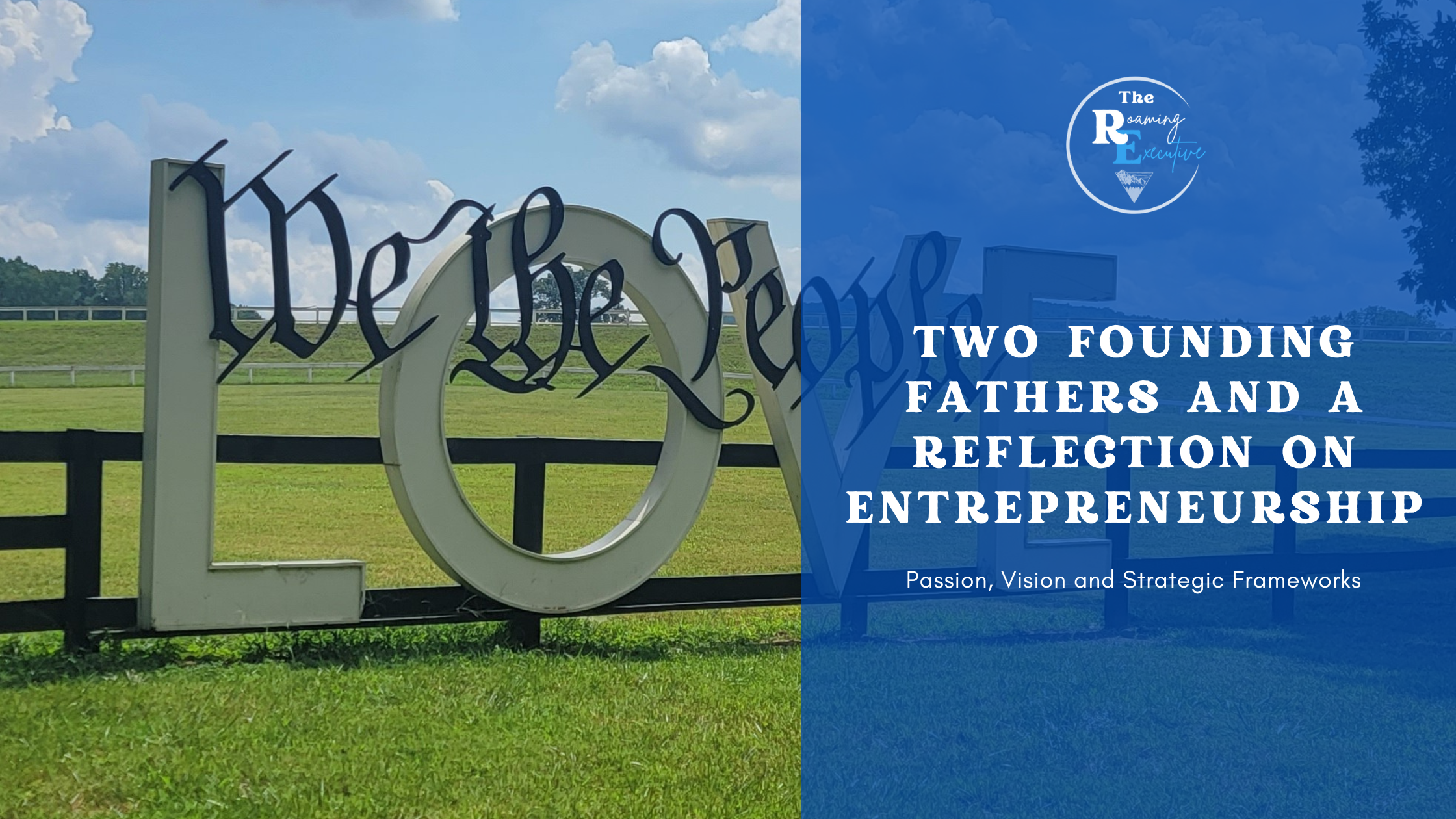
Visiting Montpelier and Monticello, the historic homes of Founding Fathers James Madison and Thomas Jefferson, was an inspiring experience for several reasons. As someone who spent the early part of my college years studying political science, I find this period of history especially fascinating. The notion that a small group of individuals could envision and create something as transformative as a new nation built on the foundation of newly proclaimed “unalienable rights”—without the technology or resources we take for granted today—might seem radical and next to impossible to younger generations. Yet, much like the Founding Fathers, modern entrepreneurs embody a similar spirit of innovation and ambition, albeit on a different scale.
What we see in the actions of the Founding Fathers is what Hamilton Helmer calls “passion, monomania and domain mastery” to fuel the invention of a new nation based upon fundamentally different beliefs than any that had preceded it. Once he decided to work on the first draft of what would later become the Constitution of the United States, James Madison requested Thomas Jefferson send him over 100 books and then locked himself away for the better part of the next year as he read, wrote and strategized.
Free from the distractions of the internet and the constant demand for instant gratification and feedback, these men devoted their time to deep reading and thoughtful reflection. This focus gave rise to ideas that shaped a new way of life for countless people. They were far from perfect—Jefferson, in particular, is a figure surrounded by controversy—but the qualities Helmer describes, such as passion and dedication, undeniably played a role in creating a nation that many have sought to emulate.
Is it possible to see the utility in this same level of focus and determination when it comes to building a successful company? Even when we feel the need to move at lightning speed, can we find the time to adequately be in discovery and reflection that could result in the production of an everlasting framework for entrepreneurial success within your enterprise?

Can this same level of focus, dedication, and deep thinking that the Founding Fathers exhibited be applied to building a successful business today? Could adopting the virtues of patience, mastery, and rigorous preparation, as exemplified by figures like Madison and Jefferson, lead to creating a more enduring and impactful business framework? What long-term benefits might arise from balancing the pressure for speed with a commitment to foundational research and strategic thought?

Similarities of an Entrepreneur and a Founding Father
Entrepreneurs share many qualities with the Founding Fathers, yet often lack the focus and domain mastery that come from years of dedicated study and freedom from distractions. The Founding Fathers had a vision they believed would benefit the masses in a new nation. They spent significant time educating themselves, engaging in thoughtful discussions, and persistently working toward their goal. Entrepreneurs like Henry Ford followed a similar path, driven by an idea that he believed could improve transportation for the masses. Both visionary efforts took innovation, close examination of the value proposition, iterative development and neither yielded immediate results. In both, the high stakes of reputation and capital were also at play.
As an entrepreneur, you also have an innovative idea that you believe will positively impact others. However, many entrepreneurs expect instant success without fully developing their vision or considering what success might look like and when it could realistically be achieved. This is where a strategic framework becomes essential. It doesn’t mean halting your progress; instead, it’s about narrowing your focus and ensuring you are well-prepared to move forward with a clear and well-defined goal.

Thomas Jefferson had a vision, and James Madison took the first step in drafting a framework to bring that vision to life. After countless discussions, debates, and revisions, the framework eventually gained support from most stakeholders. Although it continues to evolve today, that foundational framework was crucial to the success of this nation. The same principle applies to your business: creating a strong strategic foundation, refining it over time, and gaining buy-in are essential steps toward long-term success.
Do you have a foundational framework for your vision? Do you see the possibility that this could help drive your business forward?

Two Approaches to Influence: Jefferson and Madison
Thomas Jefferson, standing at 6’2″, was a charismatic inventor who thrived in social settings, where he often used his creations to entertain and engage his guests. After his wife’s early death, Jefferson never remarried but had a long-term relationship with one of his enslaved workers, with whom he fathered six children, four of whom survived to adulthood and were later freed. Despite his complex and controversial history, Jefferson’s unwavering commitment to principles like religious freedom is a key reason his legacy endures today. Even as his finances deteriorated, leading to the sale of his estate, it was bought by Uriah Levy, who credited Jefferson’s passion for religious liberty as the reason he could live freely in America. Jefferson’s boldness and confidence in his vision made him a central figure in shaping the nation.
James Madison, in contrast, was a small, quiet, and introverted man, standing at just 5’4″. Despite his unassuming presence and frail health, Madison’s intellect and strategic mind were unmatched. His estate, lavishly decorated and reflective of his taste, hints at his depth, even if it draws far less attention today than Jefferson’s. Madison’s contributions to the nation’s founding were equally significant, yet his reserved nature led to a quieter legacy. The contrast between the bustling crowds at Jefferson’s estate and the relative quiet at Madison’s speaks volumes about how personality and public image can shape historical perception.
The lesson for entrepreneurs is clear: your personality doesn’t have to determine your impact. As a self-identified introvert, I found this realization empowering. You don’t have to be a charismatic figure to make meaningful contributions. Even if you don’t capture the attention of the masses, your ideas can still resonate if they are well-founded, deeply held, and pursued with conviction.
So, which are you—the flamboyant extrovert or the passionate introvert? Can you see how either personality type, when paired with purpose and confidence, can lead to success in your entrepreneurial journey?

Reading and Thought are Still Fundamental
As my husband and I headed to dinner, we found ourselves reflecting on what we had learned about Jefferson, Madison, and their lives. One realization stood out: the most influential and thought-provoking people in history—and those in my own network—intentionally carve out time for reading and deep thought. Jefferson, Madison, and their peers would often retreat for extended periods, immersing themselves in books and contemplating the ideas within. Today, many successful politicians and entrepreneurs follow a similar practice, dedicating time to uninterrupted study and reflection.
We even extended this discussion to our kids on the drive home. In a world of instant gratification from television, YouTube, and social media, it’s easy to get swept up in quick fixes. While there’s certainly value in digital content, nothing embeds itself in your mind or sparks deep thought like reading does. Interestingly, even as an avid podcast listener, I realize that my favorite show features two hosts who dedicate themselves to reading extensively on a topic before sharing their insights.
Though I read often—especially books on business strategy—I’ve come to recognize that I might not be giving myself enough time to fully process and apply what I learn. Reading is crucial, but taking time to think through how those ideas connect to your goals and work is just as essential.
How do you intentionally create more time in your routine for both deep reading and the reflection needed to fully apply what you’ve learned to your personal and professional growth? What is your greatest source of learning – YouTube, podcasts, reading?
Two Brilliant Minds and A Reflection of Entreprenuership
The parallels between entrepreneurs and Founding Fathers like Thomas Jefferson and James Madison reveal important lessons about focus, vision, and the value of deep thought. Jefferson, a charismatic and extroverted inventor, and Madison, a quiet but brilliant strategist, both exemplified how dedication to a strong framework and relentless pursuit of a vision can lead to lasting impact. Despite their differing personalities, each contributed profoundly to the nation’s foundation, highlighting that both extroverted charisma and introverted thoughtfulness can be paths to success.
This insight applies to entrepreneurship today. Modern entrepreneurs often seek quick wins without fully developing their ideas or allowing time for strategic reflection. The Founding Fathers’ disciplined approach—educating themselves, engaging in debates, and refining their ideas—underscores the importance of building a solid framework and maintaining focus on long-term goals.
A key takeaway is the continued relevance of reading and intentional thought. Jefferson and Madison, like many successful leaders today, prioritized time for deep study and reflection. In our digital age, it’s easy to be distracted by instant gratification, but the ability to deeply engage with ideas remains critical. Even for those who prefer podcasts or online content, the most insightful lessons often come from those who invest significant time in reading and thinking.
Ultimately, whether you identify as an extroverted visionary like Jefferson or a quiet strategist like Madison, success lies in pursuing your goals with confidence, focus, and a commitment to continuous learning and reflection.
Where do you need to focus your focus? What is your passionate and relentless pursuit of vision dedicated to?
Leave a Reply